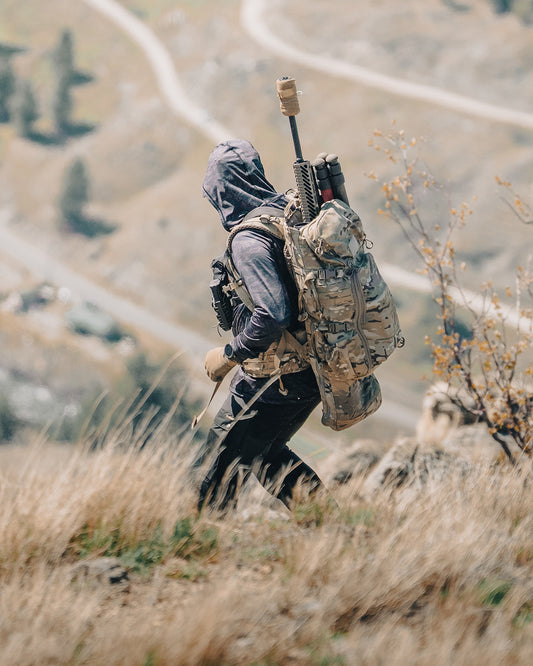
We obviously don't advocate trying to sneak up on game
with your gun or your bow in the pack. The idea here is the same
as it would be if you were using a shoulder sling: Just use the
pack to carry your gun or your bow, and then slip it into your hands
when you think you're nearing game.
But if you ever are caught by surprise and want to get
your gun or bow into your hands, you'll find that it happens very
quickly, and in a very organized way. Our packs are
designed to bring your gun or bow into a shooting position very quickly,
easily, and predictably.
Quickdraw!
You don't have to be a
double-jointed gymnast to get your gun out of the Backscabbard™.
The key to success is drawing the top shoulder
pull-straps tight, so that the top of the pack is brought as closely to
your shoulders as possible. Reach back with your left hand and
find the gun, then begin to withdraw it. Once the left arm is
extended, reach up and grasp the gun with your right hand and continue
to withdraw it. These two hand-holds usually free the gun from the
scabbard, and take as little time as un-slinging a gun from your
shoulder.
If you have limited shoulder articulation,
reach into the small of your back with your right hand as you reach for
the gun with your left; push the bottom of the pack or the scabbard away from your
body with your right hand. This will cause the butt of the gun to
move forward, and make it easier to reach with your left. Or you
can simply tug on the shoulder harness to bring the pack closer on the
side that you need to reach.
It is important to note that Eberlestock does not
recommend keeping a gun with a chambered round, or a loaded weapon, in
the Backscabbard. Also, keep in mind that you will need to be
aware of the direction that the gun's muzzle is pointed as you withdraw
it. Basic gun safety rules apply.
Eberlestock does not recommend trying to insert a
firearm into the Backscabbard™ while wearing the pack. It is best
to remove the pack, place it on a stable surface, and then insert the
firearm.
Fitting our Packs
We come in
all shapes and sizes, so it's pretty tough to design a pack that's
comfortable for everybody. But it's a rare customer indeed that
doesn't find that the Just One is a super-comfortable pack that puts a
heavy load in just the right place -- off the shoulders and onto the
pelvis.
To fit the pack to your body, start by loosening the
shoulder straps enough so that the pack settles right down onto the top
of your hips, and the bottom of the lumbar pad rests on your upper
pelvis. Then crank the waist belt tight. Next, adjust the
shoulder straps to bring the pack snugly around your shoulders.
(On the J105 or Skycrane, this is a good place to check the vertical placement of
the shoulder straps. Adjust for torso length by moving the
attachment point for comfort, and so that there is no bunching of the
shoulder strap padding). Next, buckle and adjust the chest strap for comfort, and to control
the lateral placement of the shoulder straps. Slide the sternum
strap vertically up or down (its attachment clips slide on the pack
strap webbing) as necessary. Finally, crank the
top-pull adjustment straps snug to bring the top of the pack closer to
your body.
Watch a video showing how to fit
our vertically adjustable harness system to your body:
Our
J-type packs are a different kind
of product than other hunting packs on the market. There are a few
commonly asked questions. Here are some tips:
1. Always use the main compression straps (2 horizontal and 1 or 2
vertical) to full effect: Really cranking them tight around the load
will turn the pack into a tight bundle that doesn't wash from side to
side.
2. If you pack the pack so that heavy items are in the very bottom,
then it will give a sensation of pulling aft and backwards. Two tricks
to fix this: 1) put something less dense but bulky into the very bottom
of the pack, and put heavier items up a little higher in the pack, and
as close to your body as possible. 2) if your load is meat, you can
elevate the bulk of the load of meat by pre-tightening the lower
compression strap before you load the pack. This will cause the pack to
neck down at the bottom, so that the load can't slump into the very
bottom of the utility compartment.
3. For best fit, this pack relies upon having the waist belt cranked
tightly around the top of your hip bones. Half of the hipbelt pad
should overlap the top of your hipbones, and half of the pad should be
above the top of your hipbone. In other words, the middle of the
hipbelt pad should be directly outboard of the top of the arc of your
hipbone.
4. Once you have the hipbelt in the right place, the contour of the
pack should match the contour of your body. With the pack on, look
sideways into a mirror to see if the general contour of the pack matches
the contour of your back. If not, pull out the metal stays and bend
them a little bit in the places where you can see they need to bend to
match your back. The most common adjustment is to bend the stays
slightly right above the lower part of the factory curve, so that you
have a fuller lumbar curve. (Be sure to look closely at how the stays
are inserted as you take them out. Putting them in backwards completely
alters the pack's fit and is self-critiquing, but also note that the
larger curve in the stay goes into the bottom of the pack so that it
causes the shape to protrude into your lumbar).
5. Note that on the J104 pack (which has now been replaced by the
J34), the shoulder pads will often crinkle at
the top of the pack as you put increased tension on the upper-most load
adjuster straps. This is normal on this product. There are two points
that you should know about the load adjusters: first, be sure to use
them; if they are slack, then the load will pull away from your back.
Second, don't over-tighten them, because at some point all that you're
doing is putting increased stress on your shoulders.
6. Newer models have webbing loops on the forward edge of the
scabbard. These can be used to compress the scabbard layer of the pack,
and to stabilize and condense the pack structure. But compressing this
layer may restrict access to rifles in the scabbard, so you may want to
un-lace the compression straps from the webbing loops and bypass them.
Bypassing them also allows you to get the greatest reach possible around
things being carried externally on the pack, such as Super Spike Duffel
bags.
The stays in this J107 pack have been pulled in the
field and adjusted to better fit the wearer's back. The stay on
the right has been bent above and a little more below the lower factory
bend (as shown at left, with pink highlights where the modified stay was
bent).
Fitting Your Stays in our Internal Frame Packs
We use aluminum backstays in our packs
for two reasons: you can't break 'em, and you can modify their
contour to individually fit your back, so the pack will fit you like a
glove.
We don't often talk about our
competitors, but unfortunately some of them will talk about their own
molded plastic system, or what have you, as being superior to ours.
Of course, we could use what they use, but we believe pretty strongly in
the simplicity and benefit of a customizable aluminum stay.
For example, if you need more lumbar support, slip the
stays out of the pack and increase the curvature, as shown in the photo
at left. We find it works
best to bend the stays just a little above the main arc of the factory
bend, so you get a longer, fuller curve. Then slide the stays back
in, put some weight in it, and try it out. You can keep tweaking
it until you get it just the way you like it. Basically, the goal
is to get a constant, smooth contour along your back, with no gapping.
To evaluate your pack's fit, put a moderate load in it of about 30 pounds; this will
compress the foam padding of the back panel, and at this point you should have
good contact all along the contour of your spine.
Carrying a spotting scope and tripod in a Just One
You can, of course, carry a scope and tripod
internally, in the long front pockets or the outer tuck-pockets.
But if you want to save internal space, and have quickest access to the
scope, put the assembled scope and tripod onto the pack as shown at
left, and wrap the pack around it with the compression straps.
It'll be fully protected, and when it comes time to start glassing all
that you have to do is undo two of the large compression buckles, drop
legs, and get started! (Nikon Fieldscope with Manfrotto tripod shown,
courtesy Nikon).
Carrying a Scope and Tripod in a Gunslinger
There are four or five options for
carrying a scope and tripod on a Gunslinger pack. If you're not
using the scabbard for a gun, you can pop 'em in there. Or, you
can use one of the internal hydration sleeves for your scope and attach
the tripod to the outside of the pack in one of the tuck pockets, using
the compression straps. But our personal favorite is to go with
them assembled, much the same as we do with the Just One. Put the
tripod legs in the deep front tuck pocket, and wrap the compression
straps and top cover around the scope, and it'll be locked in there
until it's time to start glassing.
Using the Spike Camp Duffel with a
Just One
The Spike Camp Duffel is designed to be carried either
internally or externally in the Just One series packs. The
lightweight duffel is great for gear, which you can then download and
leave in camp when you go out hunting with the Just One in the compact
mode.
To carry gear externally with our duffels, you can attach
them in one of two ways: for a
quick setup, just place it on the front of the pack and clip the triple
compression strap system around it. Or, to firmly attach the
duffel to the pack, zip it into the expansion zippers, as shown at
right. Note: The J2SD does not have a weather-protected
zipper, and is designed to zip to the main pack facing inward. The
J3SD, with its weather flap over the zipper, faces outward.
Our Ripcord ButtBucket is a great universal mounting kit for
carrying either a gun or a bow. It comes with our new and
improved Ripcord, and can be used with any of our
packs that are not already equipped with a Ripcord.
Once in awhile you get a load that doesn't fit inside
of the Just One. The good news is that it's a breeze to strap
stuff onto the outside of the pack. Click on the photo link at
right to see the pack in action as a traditional freighter.
Camouflage... click on the link at left.
Q
Going flying to get
to your hunt? The Just One, the Gunslinger, the Slingshot, and the
X1 make great carry-ons. The waist belts are removable (and
on scabbard packs they can be tucked up into the pack in the same pocket
that the scabbard tucks into). This way, your essential gear can
be carried on to the plane, and you'll be sure to have it when you get
there.
Backscabbards™
aren't just for guns!
Own one of
our scabbard packs, and you'll soon discover all sorts of things to use
the open-topped pocket for. You may find that the scabbard is a
perfect place to stow a laptop, tent poles, fishing rods, or your
flip-flops. Although we designed it as the ultimate place to carry
a gun, the main thing that we care about is that you enjoy your pack for
everything you'll do with it... and we know from personal experience
that you'll come to appreciate this convenient compartment for all sorts
of things.
We offer a large sized waistbelt for our packs
(bottom). It'll fit all of the new packs with removable belts, and
is good for customers with waists from 42" to 56".
Choose one as an option with your new pack, or get one
from our
Accessories page...
Link to Accessories page, to purchase our Hydration System:
Hydration Systems
We occasionally get questions about the installation
of hydration systems in our packs.
In the J34 and J107 Just One type packs, the upper pocket opposite the Backscabbard can be used for water storage;
it's sized for our WXP3L bladder, and will also work well with the
smaller WB2L. To insert the bladder, run the tube
into the pocket, and out through the portal (yellow arrow). Then
push the top end of your filled bladder up into the top of the pocket,
and then swing the bottom in.
We no longer put tube hooks on our harness because
they break too easily. On packs with our conventional harness, as
shown at left, we recommend just slipping the tube under the 1" webbing
strip that runs along the outside of the shoulder pads. On packs
with our Shooter's Harness, you have lateral webbing strips to slip the
tube under.
The X1 has a similar bladder storage location to the
Just One, opposite the scabbard, and is designed to take our WB2L
system.
In the GS05 Gunslinger and in the G287 Slingshot,
as shown at left, there
are two large interior slip
pockets in the main compartment, and each will hold a WXP3L (yes, these
packs are designed to hold 6 liters of water)! The GS05 tube
portals come are on each side outboard of the bladder sleeves. The
Slingshot's tube ports out
the eyelet at the top-center of the pack, where the shoulder harness
also goes in and out of the pack.
A note about the packs with back-wall sleeves:
we made the packs the size that they are for a number of reasons.
We have had people ask us why the hydration sleeves are narrower than
the flat hydration bladder. The answer simply is, so that we could
fit two bladders into the packs. We made the sleeves to fit
full bladders... and we've felt that holding full bladders is
what this is all about, so we haven't worried about a little wrinkling
when they're empty. If you have any doubts about whether your
bladder will fit, just fill it with water and give it a try, and you'll
see that it works fine.
Attaching Accessory Pouches to the Padlock Panels on your Packs
Eberlestock packs are fitted with a system that allows
you to attach a multitude of accessory items to your pack. Our
unique patent pending solution is a step beyond the system developed for
the US military, and is much more flexible.
The Gunslinger
is an entirely different design than the Just One. Although it's a
smaller pack, it actually has a broader scabbard. The opening is
wide enough to accept an AR-15 with a clip, any scoped or un-scoped long
gun, or a combination of guns and fishing rods, etc.
We installed "Control Clips" on the Backscabbard in
the Gunslinger in order to help you keep your stuff where you want it.
You can use them to segregate the scabbard, as shown at left, and also
to securely hold a gun; as you can see, the gun in the photo at left
isn't coming out of the scabbard until you undo the clips. If you
want to have quickest access to your gun (say you're in bear country),
you can leave the clip on one side of the pack undone, and this will
allow you to Quickdraw the gun. If you have the clips done up, and
want to get your gun out, it's an easy reach up to the clip while
wearing the pack; if you can scratch the back of your neck, you can
reach up and undo a clip on the pack... and then your gun will be ready
to slip out of the scabbard.
The clips are also used to hold the top-cover onto the
scabbard, and lock your gun into the pack.
Using the Ripcord Bowtether
Some simple tips to securely carrying a
bow on our X1 and Slingshot backpacks: